Three days later, Tycho asks what you remember.
Tycho is someone to think out loud with about whatever you're curious about — and then it comes back and finds out what stuck. Below is an actual conversation, and the review that followed it. That's the whole product; there isn't a part I'm holding back.
Ask Tycho something — no account needed.
Monday, 9:14pm
You
Why is the Moon moving away from Earth?
Tycho
Before I get into it: did you run into this somewhere, or is it something you've been chewing on? Changes which part is interesting.
You
Saw a number for it in a video and it bugged me. Something has to be pushing it.
Tycho
Right, that's the bit that feels wrong. Nothing's pushing it. It's the tides — and the tides sit on the wrong side of the Earth to be neutral about it.
You
Wrong side how?
Tycho
The Moon pulls a bulge of ocean toward itself, but the Earth spins faster than the Moon orbits, so it drags that bulge slightly ahead of the Moon. My understanding is the bulge then pulls the Moon forward, and that forward tug is what widens the orbit.
You
So the Earth is handing it energy.
Tycho
That's a good way to put it, and the Earth pays for it — the day gets longer as the Moon gets further out. I looked this up: 3.8 centimetres a year, measured by bouncing lasers off reflectors the Apollo crews left up there.
Tycho
Based on my memory, that means back in the dinosaurs' era the Earth was on something like a 22-hour day. Does that trade sound like it balances to you, or is something still off?
When it says it looked something up, you watch it do it
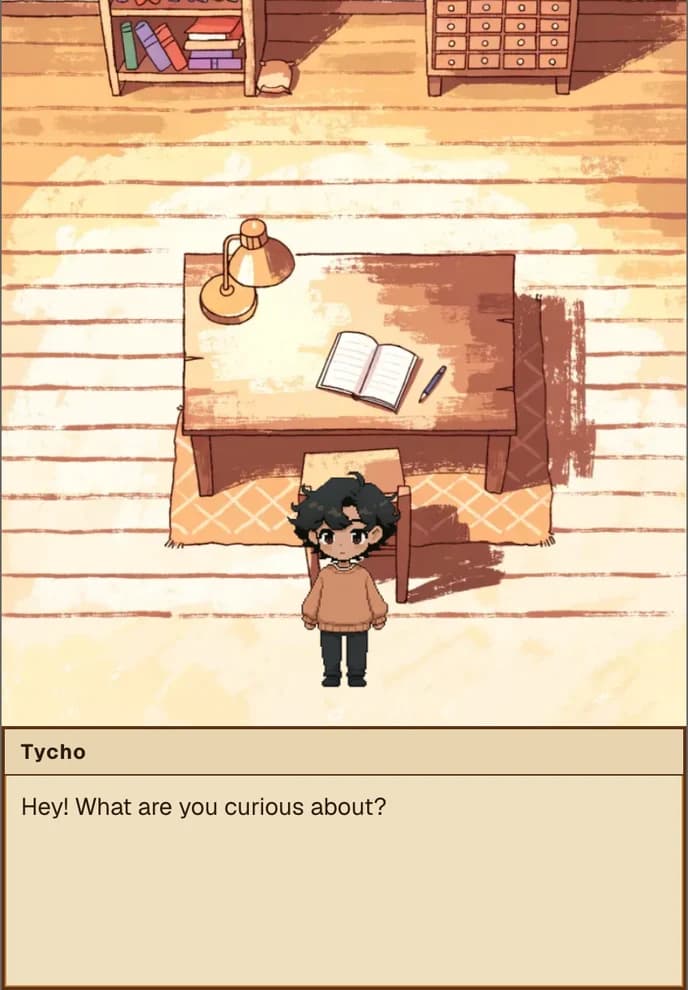
Tycho isn't a chat box on a white page. It's a small room, drawn top-down, and Tycho lives in it. When it went to check the 3.8 centimetres against Wikipedia, it got up and walked to the bookshelves. When the conversation ended it sat at the desk to write down what you'd covered, then filed the notes in the cabinet on its way out.
So the waiting is legible. You can tell the difference between it thinking and it checking, and when it checks, the source link is right there if you'd rather go read the page yourself.
Thursday, 4:00pm — an email
Subject
What do you remember about why the Moon is receding?
Hey — a while back we talked about why the Moon is receding. Good moment to find out what stuck. Not a test, just a conversation.
One click at the bottom turns these off for good, and it doesn't ask twice.
That email is the entire mechanism. You didn't schedule it. You didn't flag the conversation as important. It went out because Thursday was the day the conversation was worth reopening.
Thursday, 4:06pm — the review
Tycho
Okay, the Moon one. We were chasing why it drifts out when nothing's obviously pushing it. What comes back to you?
You
Tides. The bulge is somehow ahead of the Moon and it drags it along. I've lost why it's ahead.
Tycho
You've got the mechanism. For the ahead part — think back to what we said about which one is moving faster.
You
Oh. The Earth spins faster than the Moon goes around, so it drags the bulge past it.
Tycho
That's it. And one thing before we move on: thinking back, I don't think I had the dinosaur number quite right when we talked. Late Cretaceous was closer to a 23-and-a-half-hour day — 22 hours is a lot further back than that.
Three things happened there worth pointing at. It asked what came back to you, not what a bulge is. When you were stuck it pointed at something already in the conversation instead of handing you the answer. And it opened its own mistake without being asked — because after Monday's conversation every fact it had stated got checked, and that one didn't hold up.
If you can't explain it, you don't understand it yet — you already know the line. What's easy to miss is that it isn't advice, it's a detector. Recognition feels identical to knowledge right up until the moment you have to say the thing in your own words, with none of someone else's sentences to lean on.
Read a few all the way through
A handful of conversations are published whole — the questions, what Tycho checked against Wikipedia before the page went up, and the review a few days later.
It's a classmate, not an oracle, and that's deliberate
Read Monday again and notice what it never said: the answer is. It has two ways of talking and it stays honest about which one it's in — “my understanding is” when it's going from memory, “I looked this up” when it actually went to the shelf. Those aren't the same claim and it won't blur them.
Which means it can be wrong, and it is, sometimes. That's a design decision, not a disclaimer. When you know the person across the table might be off, you stay switched on — you push back, you bring what you already know. That's the near-peer effect, and there's a real literature behind it: Topping's work on peer learning, Vygotsky's zone of proximal development, the protégé effect. None of that is research about Tycho. It's the reason Tycho is shaped like a classmate instead of an authority.
The one thing it will never do is let a wrong fact stand. A conversation that trains you on an error is worse than one you forget.
Why Thursday, and not tomorrow
The first review lands three days out. Answer it cleanly and the next gap stretches — a week, then a fortnight, out toward about six weeks. Answer it fuzzily and it comes back in a couple of days instead, because clearly three days was too long for that one.
The general finding here is old and well replicated: pulling something back out of your own head does far more for keeping it than reading it again, and the gaps between attempts should widen. That's not a claim about Tycho, it's the ground it's built on. Tycho's only contribution is that you don't have to run the schedule.
You didn't make a card, set a reminder, or take a note
Go back through Monday and find the part that was work. There isn't one. The conversation ended, Tycho pulled the concepts out of it on its own, and the email showed up on its own.
This matters because you've almost certainly tried the alternatives. There's a folder of notes somewhere you haven't reopened since you wrote them. There's a deck you built forty entries into and abandoned in March — you may even know exactly which app, and that the science behind it is real. Nobody makes the cards. Making the cards is a second job you'd be doing at 11pm about a topic you were enjoying twenty minutes ago.
And the chat window you've been learning in for two years has excellent conversations and no memory of any of them — every session starts from zero, and nothing ever comes back to ask.
There is nothing here to maintain. You talk. It comes back.
What it costs, and what free actually means
You can talk to Tycho right now without an account — no email, no card, nothing kept. Close the tab and it's gone.
Sign up and the first three conversations get kept properly: notes made, intervals set, brought back to you like the one above. That's free and it stays free.
After three, here's the honest version. Tycho doesn't lock. You can keep talking as much as you want, full conversations, Wikipedia and all — it just stops keeping them, which means they stop coming back. So the free tier isn't a door slammed in your face; it's the conversation without the part that makes it stick. Which is, admittedly, the part you came for.
$12 a month or $99 a year lifts the cap. Checkout goes through Stripe, cancel whenever you like, and there's no expiring trial underneath any of it.
About the name
Tycho Brahe spent decades taking the most precise measurements of the sky anyone had ever taken. He never worked out the laws hiding in them — Kepler did that, with Tycho's numbers. One of them gathered the knowledge; the other one did the understanding.
That's the arrangement here, and it's the right way round: Tycho keeps track. You're the one who ends up understanding it.
Built by one person who had this problem
I watch the same things you probably do — Veritasium, PBS Space Time, three-hour podcasts, Quanta on a Sunday — and I got tired of the gap between feeling like I'd learned something on Monday and being able to explain roughly none of it by the end of the month. Nothing I tried fixed it, so I built this. No investors, no growth team, no launch. There are no testimonials on this page because there aren't enough users yet to quote anyone honestly.
So, plainly, on the things people ask: your conversations are stored, because storing them is the mechanism, and they're sent to a model provider to get answered. They are not sold, and they are not used to train a model of mine. You can export all of it or delete all of it from settings. That's the whole promise and I'm not going to inflate it.
The fastest way to find out whether this works for you is to ask it something you're actually curious about and then see what it sends you on Thursday.